Ministry of Jal Shakti · Minister of State since June 2024
Jal Shakti
Water for homes, fields and aquifers. The ministry’s work, the country’s data, and the documented part played by its Minister of State.
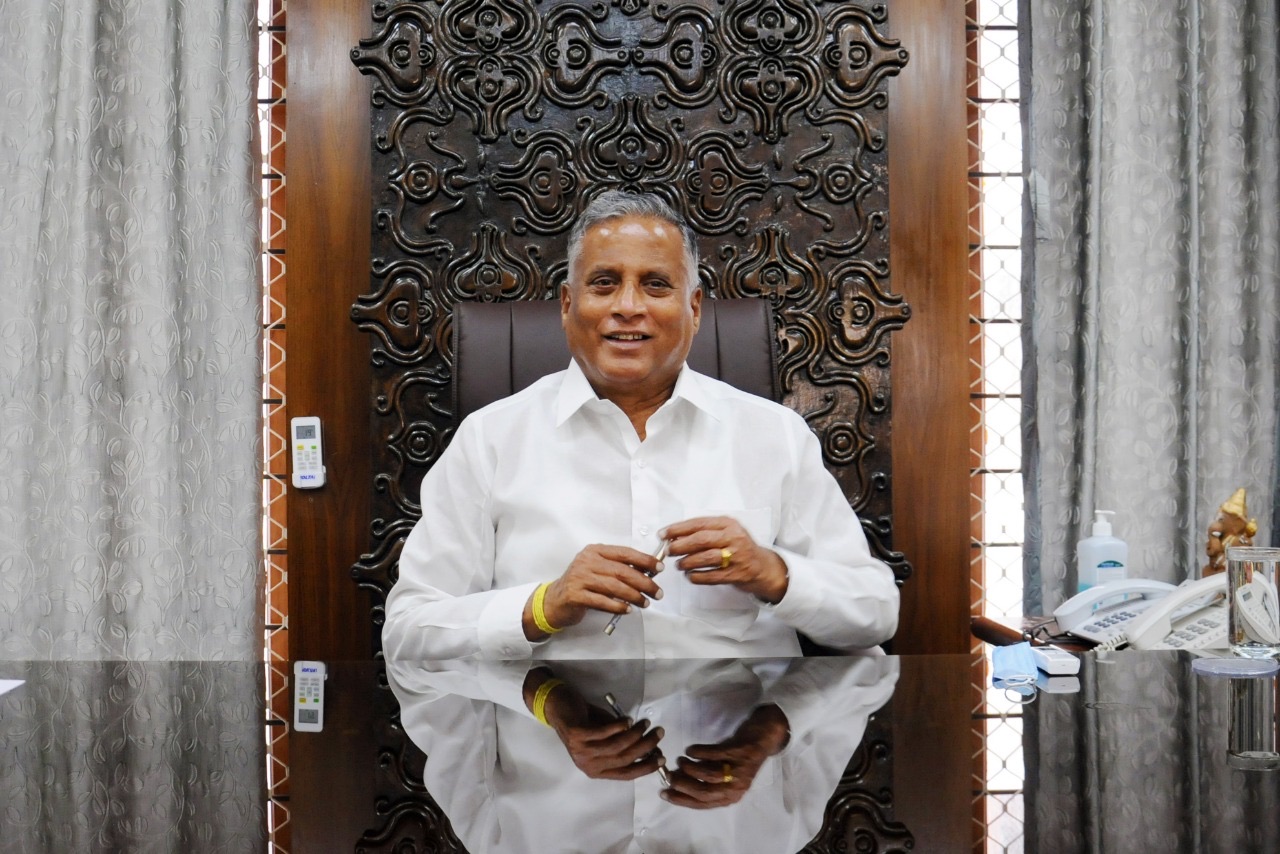
V. Somanna took charge as Minister of State in the Ministry of Jal Shakti on 12 June 2024. The sections below explain India’s water situation using the ministry’s own figures. The last section lists his documented Jal Shakti engagements, his parliamentary replies and his signed messages in national groundwater reports.
India’s water context
According to the Ministry of Jal Shakti, India is home to about 18% of the world’s population but has only about 4% of its freshwater resources. Rainfall is concentrated in a few monsoon months and unevenly spread across regions. Large parts of the country rely on groundwater through the dry season.
The Ministry of Jal Shakti was formed in May 2019 by merging two departments: the Department of Water Resources, River Development & Ganga Rejuvenation and the Department of Drinking Water & Sanitation. It is headed by the Minister of Jal Shakti, and two Ministers of State, including V. Somanna, assist.
Groundwater
Groundwater is India’s most widely used water source. According to a PIB backgrounder (January 2026), it meets nearly 62% of irrigation needs, 85% of rural consumption and 50% of urban demand. The Central Ground Water Board and the States/UTs jointly assess the resource at the level of blocks, taluks and mandals. They classify each unit as safe, semi-critical, critical, over-exploited or saline, according to how much of the recharge is being extracted.
Karnataka. The 2025 assessment puts Karnataka’s stage of groundwater extraction at 66.49%, above the national figure: 11.58 bcm extracted against 17.41 bcm extractable. In the 2024 state assessment, 45 of Karnataka’s 237 taluks were categorised as over-exploited.
Established by the assessment
The figures above, including extraction, categories and trends, are the findings of the joint CGWB–State assessment published by the ministry.
From his message
The observations on drought resilience, dependence and unplanned exploitation are the Minister of State’s views as published in the report. They are not independent findings.
Drinking water
The Jal Jeevan Mission (JJM), run by the Department of Drinking Water & Sanitation with the States, aims to provide a functional household tap connection to every rural home. When the mission began in August 2019, 3.23 crore rural households had tap water. The Mission has since been extended to December 2028 as JJM 2.0, and its guidelines were released on World Water Day 2026.
Water quality is part of the same effort. A written reply given by V. Somanna in the Lok Sabha on 5 February 2026 records more than 2,800 water-testing laboratories. It also records 24.8 lakh women trained to use field test kits in their villages.
Water conservation
The Jal Shakti Abhiyan, begun in 2019 and run since 2021 as “Catch the Rain”, is a campaign to build and revive water-harvesting structures, from ponds and tanks to recharge wells, with district administrations and communities. The national groundwater assessment reflects its effect on recharge: recharge from tanks, ponds and water-conservation structures rose from 13.98 bcm in 2017 to 25.34 bcm in 2024.
Recognition and participation are part of the approach. The National Water Awards recognise states, districts, panchayats and institutions, and Jal Mahotsav in 2026 was a nationwide programme that closed on World Water Day. PIB records that at the close of Jal Mahotsav on 22 March 2026, V. Somanna said water conservation “must become a daily collective responsibility”.
Irrigation
Irrigation investment is organised under the Pradhan Mantri Krishi Sinchayee Yojana (PMKSY), which has four components, split between ministries:
- Ministry of Jal Shakti: the Accelerated Irrigation Benefit Programme (AIBP), which funds the completion of major and medium irrigation projects, and Har Khet Ko Pani, which covers command-area development and surface minor irrigation.
- Other ministries: Per Drop More Crop (micro-irrigation) and Watershed Development.
Because most irrigation in India depends on groundwater, irrigation policy and groundwater management are closely linked. That link runs through the ministry’s assessments and the Atal Bhujal Yojana described below.
Water security
Water security depends on whether the resource can keep meeting demand. At national level, the share of over-exploited groundwater assessment units fell from 17.2% in 2017 to 10.8% in 2025, and total annual recharge rose from 432 bcm to 448.52 bcm over the same period, according to official assessments.
The Atal Bhujal Yojana is the ministry’s community-led groundwater management scheme. It was launched on 25 December 2019 and implemented from April 2020 in 8,220 water-stressed gram panchayats in 80 districts across seven states, including Karnataka. The ministry reports more than 83,000 recharge structures built and over 9 lakh hectares brought under efficient irrigation practices.
Sustainable water management
Managing water sustainably means knowing what exists, what is withdrawn and what is returned. The annual groundwater assessments, now run through the IN-GRES web platform, are the ministry’s main measurement tool.
In his message in the 2024 edition of the national groundwater compilation, dated 27 December 2024, V. Somanna noted that “around 70% of India is characterized by hard rock formations”. He wrote that, “considering our heavy dependence on ground water”, judicious development of the resource is “the need of the hour”.
Documented ministerial engagements
Only activities in which official records name V. Somanna are listed. Ministry-wide results above belong to the ministry and its State partners.
-
22 Mar 2026
World Water Day: close of Jal Mahotsav, release of JJM 2.0 guidelines
Spoke at the close of Jal Mahotsav on World Water Day, when the Jal Jeevan Mission 2.0 guidelines were released. PIB reports him saying that water conservation “must become a daily collective responsibility”.
-
Mar 2026
Jal Mahotsav 2026 national event
Attended the national Jal Mahotsav 2026 event, held in the presence of the President of India.
-
5 Feb 2026
Written reply: sustainability of water sources (USQ 951)
Written reply recording that rural households with tap water rose from 3.23 crore (16.72%) in August 2019 to over 15.79 crore (81.57%) by 28 January 2026. It also notes more than 2,800 water-testing laboratories and 24.8 lakh women trained to use field test kits.
-
27 Jan 2026
“Samvad Samaroh” with WaSH Warriors invited for Republic Day
Present, with the Minister of Jal Shakti and the other Minister of State, at an interaction with 58 water, sanitation and hygiene (WaSH) workers invited as Republic Day guests.
-
19 Dec 2025
Sujal Gram Samvad: interaction with Kodi Gram Panchayat, Udupi
At the second edition of Sujal Gram Samvad, he spoke in Kannada with representatives of Kodi Gram Panchayat in Udupi district, Karnataka, about its 24×7 water supply, field-test-kit water quality checks and Nal Jal Mitras.
-
4 Dec 2025
Written reply: complaints under Har Ghar Nal Se Jal (USQ 804)
Written reply stating that more than 2.68 lakh villages had been certified “Har Ghar Jal”, and that complaints are handled through the CPGRAMS grievance portal.
-
Nov 2025
Message in the National Compilation on Dynamic Ground Water Resources, 2025
His message in the 2025 national groundwater compilation observes that regions with a sustainable groundwater balance are shrinking worldwide. It describes groundwater as a natural safeguard against drought, and notes that growing dependence has led to “extensive—and sometimes unplanned—exploitation”.
-
14 Aug 2025
Interaction with sarpanches on the eve of Independence Day
Met more than 150 sarpanches invited as special guests. Booklets on community water work were released, including “JSA: Catch the Rain 2025 – Voices from the Field”.
-
27 Mar 2025
Written reply: targets under Har Ghar Nal Se Jal and SBM (G)
Written reply recording that rural tap water coverage rose from a baseline of 3.23 crore households (16.8%) in August 2019 to about 15.54 crore households (80.29%) as of 24 March 2025.
-
17 Mar 2025
Written reply: tap water connections under Jal Jeevan Mission
Gave a written reply on tap water connections under the Jal Jeevan Mission, setting out the mission’s framework and pointing members to the public JJM dashboard.
-
27 Dec 2024
Message in the National Compilation on Dynamic Ground Water Resources, 2024
His signed message in the 2024 national groundwater compilation notes that about 70% of India is underlain by hard rock formations. It calls judicious development of groundwater “the need of the hour”, given the country’s heavy dependence on it.
-
14 Oct 2024
Announcement of the 5th National Water Awards
Attended the announcement of the 5th National Water Awards with the Minister of Jal Shakti and the other Minister of State. There were 38 winners across 9 categories.
-
12 Jun 2024
Takes charge as Minister of State for Jal Shakti
Took charge at the Ministry of Jal Shakti. According to PIB, he spoke to the media about the Jal Jeevan Mission and the rural sanitation (ODF Plus) programme, and was welcomed by the Secretary, Department of Drinking Water and Sanitation.
Sources
- CGWB, National Compilation on Dynamic Ground Water Resources of India 2025: cgwb.gov.in; 2024 edition: cgwb.gov.in
- PIB, groundwater assessment 2024 (31 Dec 2024): PRID 2089039; 2025 figures (18 Dec 2025, 29 Jan 2026): PRID 2206073, PRID 2220203
- PIB, groundwater dependence backgrounder (22 Jan 2026): PRID 2217195; population and freshwater share (29 Mar 2022): PRID 1811005
- Jal Jeevan Mission coverage (PIB, 14 Aug 2026): PRID 2299487; JJM 2.0 (22 Mar 2026): PRID 2243565
- Karnataka groundwater, 2024 state assessment (CGWB/GWD, Mar 2025): cgwb.gov.in